VERY HIGH MYOPIA


VERY HIGH MYOPIA
INTRODUCTION
Vision is something many of us use every moment of every day without thinking about it. But for people living with severe or very high myopia, seeing clearly can become a daily challenge.
Very high myopia is more than simply needing stronger eyeglasses. Severe myopia can be associated with structural changes in the eye and a higher risk of serious eye complications, including retinal detachment, glaucoma, cataracts, and other retinal problems.
-
WHAT IS MYOPIA?
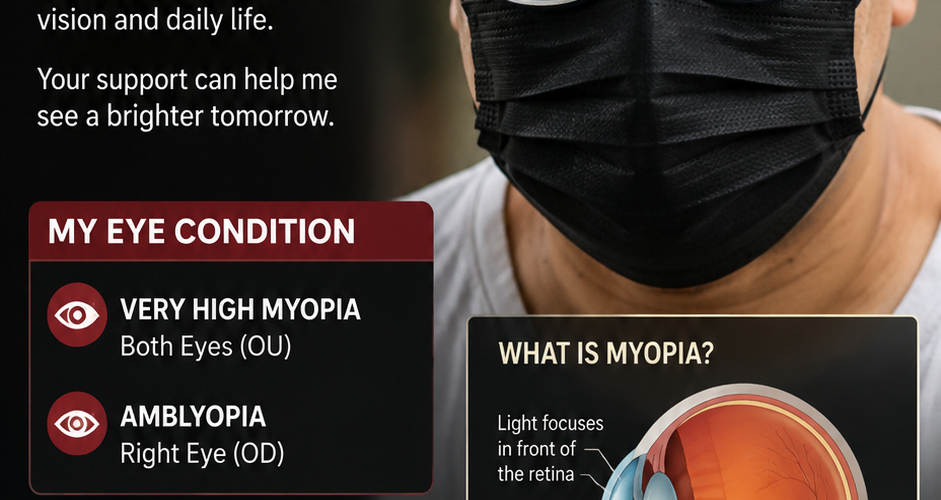
Myopia, also known as nearsightedness, is a refractive error in which distant objects appear blurry while objects closer to the eyes may be seen more clearly.
Normally, light entering the eye should focus directly on the retina. In myopia, the eye is often too long from front to back, causing incoming light to focus in front of the retina instead of directly on it.
-
WHAT IS VERY HIGH OR HIGH MYOPIA?
High myopia is commonly defined as approximately -6.00 diopters or greater. Some ophthalmology references also use an axial eye length of approximately 26.5 mm or more as a criterion.
The important point is that high myopia is not only about the strength of a glasses prescription. In some people, the eye becomes elongated, which can stretch and thin tissues at the back of the eye.
That structural change is one reason high myopia deserves careful long-term monitoring.
2.1 CLASSIFICATION OF MYOPIA
- Low Myopia
Generally less than -3.00 diopters. - Moderate Myopia
Generally between -3.00 and -6.00 diopters. - High Myopia
Generally -6.00 diopters or greater. - Very High or Severe Myopia
This term may be used informally for particularly strong prescriptions or significant pathological changes. There is no single universally accepted additional diopter threshold that separates “very high” from “high” myopia.
The exact classification should be determined by an eye-care professional based on the prescription and the physical condition of the eye.
-
WHY DOES VERY HIGH MYOPIA HAPPEN?
There is no single cause in every person. Factors can include:
3.1 GENETICS AND FAMILY HISTORY
People with parents or close relatives who are myopic may have a greater likelihood of developing myopia.
3.2 EYE GROWTH
A major mechanism is excessive elongation of the eyeball from front to back. This changes where light focuses and can also contribute to structural stress on the retina and other tissues.
3.3 CHILDHOOD DEVELOPMENT
Myopia commonly begins during childhood or adolescence and may progress as the eyes grow.
3.4 ENVIRONMENTAL AND LIFESTYLE FACTORS
For children, spending more time outdoors appears to be associated with a lower risk of developing myopia, while intensive near-work activity has been associated with myopia development and progression.
-
WHAT ARE THE SYMPTOMS?
Common symptoms of myopia can include:
4.1 Blurred distance vision
4.2 Difficulty reading signs from far away
4.3 Squinting to see distant objects
4.4 Eye strain
4.5 Headaches in some people
4.6 Difficulty recognizing faces or objects at a distance
4.7 Needing increasingly strong glasses or contact lenses
The severity of symptoms varies considerably between individuals.
-
WHY IS VERY HIGH MYOPIA MORE CONCERNING?
Ordinary myopia can often be corrected very effectively with glasses or contact lenses. However, high myopia can also involve physical changes to the eye.
People with severe myopia have an increased risk of conditions such as:
5.1 Retinal Tears And Retinal Detachment
5.2 Myopic Retinal Or Macular Degeneration
5.3 Glaucoma
5.4 Cataracts
5.5 Abnormal Blood-Vessel Growth Beneath The Retina
Some of these complications can cause permanent vision loss, which is why high myopia deserves regular professional monitoring.
-
WHAT IS RETINAL DETACHMENT?
The retina is the light-sensitive tissue at the back of the eye. A retinal detachment occurs when the retina separates from its normal position.
High myopia is one of the factors associated with increased retinal-detachment risk.
6.1 WARNING SYMPTOMS
- A sudden increase in floaters
- Flashes of light
- A dark curtain or shadow moving across the field of vision
- A sudden decrease or change in vision
These symptoms require urgent eye evaluation because retinal detachment can threaten sight.
-
HOW IS VERY HIGH MYOPIA DIAGNOSED?
An eye-care professional may perform several examinations, depending on the patient’s situation.
These can include:
7.1 Visual-acuity testing
7.2 Refraction testing
7.3 Eye-pressure measurement
7.4 A comprehensive eye examination
7.5 Dilated retinal examination
7.6 Assessment of the retina and optic nerve
7.7 Measurement of the eye’s axial length when appropriate
7.8 Additional retinal imaging or other tests when clinically indicated
A comprehensive eye examination is particularly important when someone has severe myopia because the doctor needs to assess more than simply the glasses prescription.
-
REMEDIES AND TREATMENT OPTIONS
There is no single treatment that is appropriate for everyone with very high myopia. Treatment depends on age, prescription, eye structure, retinal health, visual needs, and whether complications are present.
8.1 EYEGLASSES
Glasses are one of the simplest and safest ways to correct refractive errors.
PROS:
- Non-invasive
- No procedure is required
- Can provide substantial improvement in distance vision
- Generally straightforward to replace or update
CONS:
- Very strong prescriptions can produce thicker or heavier lenses
- Some people may experience distortion or reduced peripheral vision with very strong prescriptions
- Glasses correct the refractive error but do not necessarily eliminate the underlying structural risks associated with high myopia
8.2 CONTACT LENSES

Contact lenses can provide another way of correcting high refractive errors.
PROS:
- Can provide a wider field of vision than glasses
- Do not have the same thick-lens appearance
- Can be convenient for some activities
CONS:
- Require careful hygiene and proper handling
- Can cause discomfort or complications if worn incorrectly
- Not everyone is a suitable candidate
- They do not remove the underlying risk associated with highly elongated eyes
8.3 LASER REFRACTIVE SURGERY
Some adults may be candidates for procedures that reshape the cornea to correct refractive error.
PROS:
- Can reduce dependence on glasses or contact lenses
- No daily glasses may be needed for distance vision after successful treatment
CONS:
- Not everyone with high myopia is a suitable candidate
- The suitability of surgery depends on factors such as corneal health, eye structure, prescription, age, and overall ocular health
- Laser surgery corrects the refractive error but does not necessarily eliminate the retinal risks associated with high myopia
A specialist should determine whether a particular surgical procedure is appropriate.
8.4 OTHER EYE PROCEDURES AND SURGERY
Some people with severe refractive errors or additional eye conditions may require other surgical approaches. The appropriate procedure depends entirely on the individual’s diagnosis.
Importantly, surgery is not automatically a “cure” for high myopia. A person can have their refractive error corrected and still require long-term retinal monitoring if the eye has structural changes associated with high myopia.
8.5 TREATMENT OF COMPLICATIONS
If high myopia causes a specific complication, treatment is directed at that complication.
For example, certain abnormal blood-vessel growth beneath the retina can require specialized treatment. Retinal tears or retinal detachment may require urgent procedures or surgery.
This is why managing high myopia is not simply about getting stronger glasses. The health of the retina and the rest of the eye also matters.
-
CAN VERY HIGH MYOPIA BE REVERSED?
This is an important distinction.
Glasses, contact lenses, and refractive surgery can correct the focusing problem and improve visual clarity. However, they do not necessarily reverse the underlying elongation of the eyeball associated with high or pathological myopia.
Current management therefore focuses on achieving the best possible vision, monitoring the eyes, and identifying and treating complications as early as possible.
-
CAN MYOPIA BE PREVENTED OR SLOWED?
For children and adolescents, there are approaches that may help delay the onset or slow progression of myopia. These can include increased outdoor time, regular breaks during near work, and appropriate optical interventions.
However, management of established high or pathological myopia in an individual adult is different. People should discuss their particular situation with an ophthalmologist rather than relying on general internet advice.
-
THE IMPORTANCE OF REGULAR EYE EXAMINATIONS
Someone with very high myopia should not assume that good vision through glasses means the eyes are completely healthy.
Regular examinations can help doctors monitor the retina, optic nerve, eye pressure, visual acuity, and other aspects of eye health.
Early detection of complications can be extremely important because some conditions may be treatable before significant additional vision is lost.
-
MY PERSONAL EYE PROBLEM
This subject is especially personal to me because I am living with very high myopia myself.
During my examination at Sarabia Vision Eye Specialist Clinic, my medical assessment documented:
Very High Myopia, OU — meaning very high myopia in both eyes.
Amblyopia, OD — amblyopia affecting my right eye.
My recorded visual acuity was:
Right eye (OD): Counting fingers at 2 feet
Left eye (OS): 20/200
These results show how severely my vision is affected, particularly in my right eye.
For me, this is not simply a medical term written on a piece of paper. It affects my everyday life and my ability to see the world around me.
I am now seeking the medical care and treatment recommended for my eyes, including the possibility of surgery as part of my treatment journey. The financial cost of receiving the care I need is a major challenge.
-
I AM HUMBLY ASKING FOR YOUR SUPPORT
I am reaching out to friends, family, kind-hearted individuals, and anyone who believes in helping someone protect their vision.
If you are able to make a donation, any amount would mean a great deal to me and would help toward my eye treatment and surgery expenses.
If you cannot donate, sharing my fundraising campaign with others would also be an enormous help.
Every donation, every share, and every prayer gives me hope.
MY FUNDRAISING CAMPAIGN IS HERE:
https://gogetfunding.com/invisible-to-you-life-changing-to-me-help-me-save-my-sight/
Thank you for taking the time to read my story.
Thank you to everyone who has supported me, encouraged me, prayed for me, or helped share my campaign.
For many people, being able to see is something ordinary.
For me, protecting my remaining vision is a fight that matters deeply.
Please help me save my sight.
- IMPORTANT MEDICAL DISCLAIMER
This article is intended for education and to explain my personal experience. It is not a diagnosis or a substitute for professional medical advice. Very high myopia can vary significantly from person to person, and treatment decisions should be made with a qualified ophthalmologist who has examined the individual patient.

