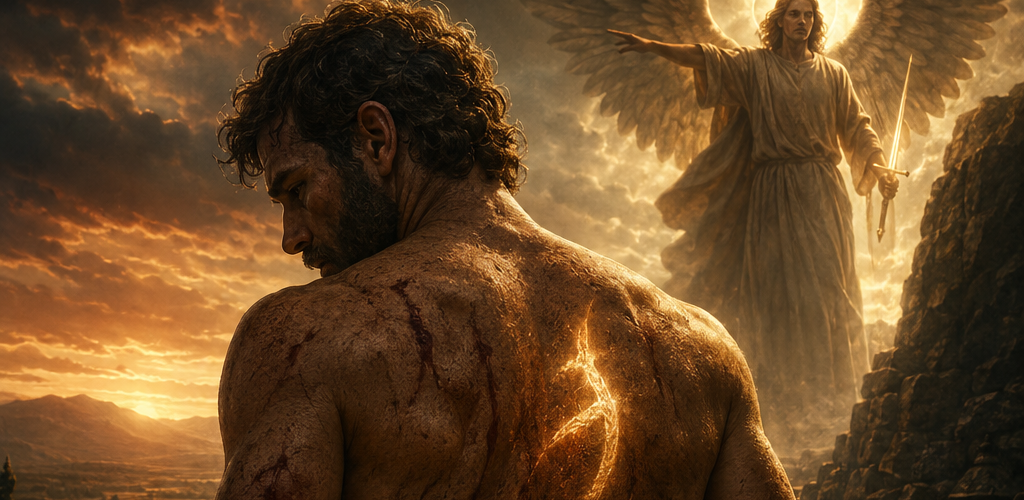
TRUE CATHOLIC BIBLE-BASED TRUE STORY: THE MARK GOD PLACED UPON CAIN


TRUE CATHOLIC BIBLE-BASED TRUE STORY: THE MARK GOD PLACED UPON CAIN
THE MARK WAS NOT A SIGN OF APPROVAL
What kind of mark would God place upon a man who had murdered his own brother? Would it be a reward? A sign of innocence? Or something far more mysterious?
The answer is found in one of the most sobering passages of Genesis. Cain, the firstborn of Adam and Eve, became a husbandman, while his brother Abel was a shepherd. Both brought offerings to God. Abel offered “of the firstlings of his flock, and of their fat,” and the Lord had respect to Abel and his offering. But Cain’s offering was not accepted. Genesis 4:1-5.
Cain became exceedingly angry, and his countenance fell. Yet God did not immediately abandon him. The Lord warned him: “If thou do well, shalt thou not receive? but if ill, shall not sin forthwith be present at the door? but the lust thereof shall be under thee, and thou shalt have dominion over it.” Genesis 4:7.
The warning was merciful. Cain was being confronted before his anger became destruction. But Cain did not master the sin crouching at his door.
He went with Abel into the field. There, Cain rose against his brother and killed him.
Then came the divine question: “Where is thy brother Abel?” Cain answered, “I know not: am I my brother’s keeper?” Genesis 4:9.
But God already knew. “What hast thou done?” the Lord asked. “The voice of thy brother’s blood crieth to me from the earth.” Genesis 4:10.
Cain was judged. The earth would no longer yield its strength to him, and he would become “a fugitive and a vagabond” upon the earth. Genesis 4:11-12.
Then Cain spoke of his fear. He believed that whoever found him would kill him. His words reveal something important: the murderer himself now feared death.
And here the story takes its astonishing turn.
God did not permit Cain to be killed. The Lord declared: “No, it shall not be so: but whosoever shall kill Cain, shall be punished sevenfold. And the Lord set a mark upon Cain, that whosoever found him should not kill him.” Genesis 4:15.
The Bible tells us that God placed a mark upon Cain. But Scripture does not tell us exactly what that mark looked like. The Douay-Rheims commentary mentions an interpretation that it may have involved trembling or terror in his appearance, but this is commentary, not a biblical statement. We must therefore leave the precise nature of the mark where Scripture leaves it: unrevealed.
The mark was not forgiveness of the murder. Cain remained under judgment and went “from the face of the Lord.” Genesis 4:16. Yet the same God who judged Cain also restrained further bloodshed.
This is the mystery: divine justice and divine mercy appear together.
Centuries later, Saint John would explicitly return to Cain as a warning to Christians. “Not as Cain, who was of the wicked one, and killed his brother. And wherefore did he kill him? Because his own works were wicked: and his brother’s just.” 1 John 3:12.
The lesson is frighteningly close to the human heart. Sin does not always begin with an outward act. Cain first became angry. God warned him. He was given the opportunity to master sin. But he surrendered himself to it.
And Scripture gives us an even deeper contrast. Hebrews tells us that Abel offered his sacrifice in faith: “By faith Abel offered to God a sacrifice exceeding that of Cain.” Hebrews 11:4.
THE CATHOLIC LESSON
The mark of Cain must never be understood as God’s approval of sin. It was a sign of God’s judgment and protection within that judgment. Cain was guilty, yet God prevented vengeance from becoming another killing.
For Catholics, this is a solemn reminder that justice belongs to God. We must never nourish hatred until it becomes action. Saint John teaches that hatred itself is spiritually dangerous: “Whosoever hateth his brother is a murderer.” 1 John 3:15.
The story also points us toward Christ. Cain answered his brother’s blood with violence. Christ, however, gives Himself for sinners. Abel’s blood cried from the earth; the Gospel reveals the greater mercy of Christ, whose sacrifice calls sinners not toward revenge, but toward repentance, forgiveness, and salvation.
WHAT THE DOUAY-RHEIMS BIBLE REVEALS
Genesis 4:7: “If thou do well, shalt thou not receive?”
Genesis 4:10: “The voice of thy brother’s blood crieth to me from the earth.”
Genesis 4:15: “And the Lord set a mark upon Cain, that whosoever found him should not kill him.”
Genesis 4:16: “And Cain went out from the face of the Lord.”
1 John 3:12: “Not as Cain, who was of the wicked one, and killed his brother.”
Hebrews 11:4: “By faith Abel offered to God a sacrifice exceeding that of Cain.”
A PRAYER INSPIRED BY THE STORY
Lord Jesus Christ, preserve my heart from anger, hatred, envy, and every sin that seeks to master me. Give me grace to repent quickly when I fall, to love my neighbour, and to trust Your justice and mercy. May the sacrifice of Your Sacred Heart teach me to answer hatred with charity and sin with repentance. Amen.
FINAL REFLECTION
Cain’s mark remains mysterious because Scripture does not tell us exactly what it was. But its purpose is clear: God judged Cain, yet God also restrained further bloodshed.
Never mistake God’s patience for permission to sin. When anger rises, remember the warning given to Cain: sin seeks mastery, but we must resist it.
Bring your anger to Christ before it becomes hatred. Bring your hatred to Christ before it becomes harm. And when you have sinned, do not run farther from God. Turn back to Him in repentance.
The God who confronted Cain is also the God who calls sinners to conversion. His justice is real. His mercy is real. And in Jesus Christ, mercy calls us home.

