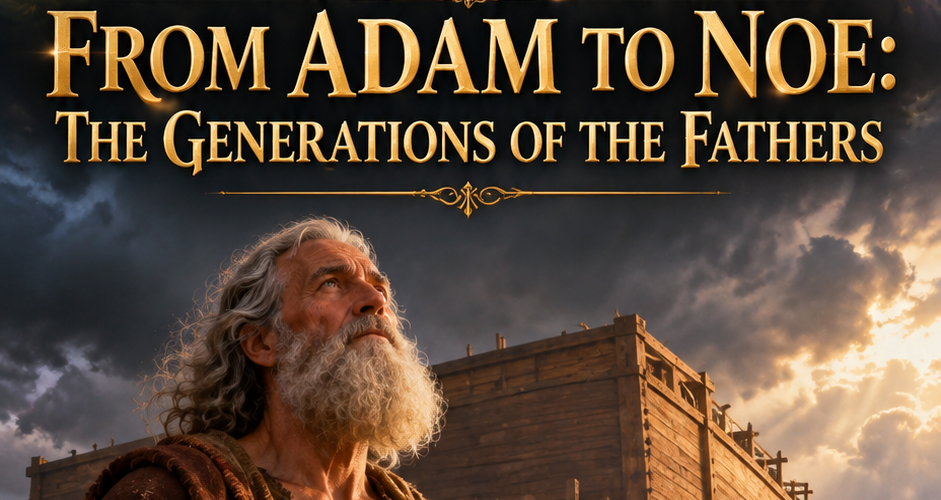
FROM ADAM TO NOE: THE GENERATIONS OF THE FATHERS


THE UNTOLD BIBLE TRUE STORY:
FROM ADAM TO NOE: THE GENERATIONS OF THE FATHERS
The Primary Passage
The principal passage is Genesis 5:1–32, the genealogy “of the book of the generation of Adam,” beginning with Adam and reaching Noe. Its essential context begins in Genesis 1–4: God created man in His image; Adam and Eve fell into sin; Cain killed Abel; Seth was born; and humanity continued to multiply. Genesis 5 then traces the line from Adam through Seth to Noe, before Genesis 6 describes the corruption of the earth and God’s command to Noe to prepare the ark.
Scripture explicitly names the fathers and their sons, gives the ages of many of them, and repeatedly records that each died. The genealogy culminates in Noe, whose name is associated with consolation: “This same shall comfort us from the works and labours of our hands.”
The Story
Genesis 5 can appear at first to be only a long list of names and ages. Yet within those names lies one of Scripture’s quietest testimonies about human mortality and God’s providence.
Adam begot Seth. Seth begot Enos. Enos begot Cainan. Cainan begot Malaleel. Malaleel begot Jared. Jared begot Henoch. Henoch begot Mathusala. Mathusala begot Lamech. And Lamech begot Noe.
Generation followed generation.
The years recorded are extraordinary by modern reckoning, but the repeated conclusion is strikingly simple: “and he died.”
Adam lived nine hundred and thirty years, “and he died.” Seth lived nine hundred and twelve years, “and he died.” The same solemn pattern continues through the genealogy.
But one man interrupts the pattern.
Of Henoch, Genesis says: “And he walked with God, and was seen no more: because God took him.” Scripture does not record his death in the ordinary formula used for the others.
This is not a story of forgotten men. It is Scripture reminding us that every generation stands before God. Fathers beget sons; sons become fathers; years pass; and human life moves toward death. Yet God’s purposes continue.
Then comes Noe.

Lamech names his son Noe, saying that he will bring consolation amid the toil of fallen human existence. Soon afterward, Genesis reveals why Noe matters. “Noe found grace before the Lord.” While the earth had become corrupted, Noe was described as “a just and perfect man in his generations,” and “he walked with God.”
God then commanded him to make the ark.
What Scripture Does Not Tell Us
Genesis does not provide conversations between these patriarchs, descriptions of their daily lives, or explanations of what they personally felt about their extraordinary lifespans. We should not invent such details. The genealogy gives us something more austere: names, generations, ages, births, deaths, and the continuing action of God.
What We Must Not Miss
The overlooked detail is Henoch.
The genealogy repeatedly says, “and he died,” but when it reaches Henoch, Scripture says that he “walked with God.” His extraordinary departure stands like a light within a chapter dominated by mortality.
The lesson is not that faithful people will necessarily escape death. Scripture itself later teaches the universality of death. Rather, Henoch’s life shows the supreme importance of walking with God. His life was not ultimately defined by its length, but by its relationship with God.
The Spiritual Heart
Genesis 5 teaches us to see our own lives differently. We may measure existence by years, achievements, possessions, or family milestones. Scripture places another measure before us: Do we walk with God?
The genealogy also prepares us to understand Noe. He lived in a corrupt world, yet Scripture identifies him as just and obedient. His salvation through the flood becomes part of the biblical preparation for the greater work of salvation fulfilled in Christ.
The Catholic Church venerates Henoch and Noe among the righteous figures of the Old Testament and reads the history of the flood within the wider mystery of salvation. The ark itself is explicitly connected by Saint Peter with Christian baptism in 1 Peter 3:20–21. The connection is therefore not invented symbolism, but part of the apostolic reading of Scripture.
Final Reflection
The names in Genesis 5 are easy to skip. But Scripture placed them there for a reason.
They remind us that generations pass, death is real, sin wounds humanity, and yet God does not abandon His purposes. From Adam to Noe, the history moves forward under divine providence.
Our own names will one day belong to another generation’s memory. What will matter most is not how long we were here, but whether we walked with God.
Let us therefore seek the grace to live faithfully in our own generation, trusting God through suffering, resisting sin, obeying His word, and placing our hope in the salvation accomplished through Jesus Christ.
Closing Prayer
O God, Father of every generation, teach us to remember that our earthly life is passing, yet Your mercy endures. Give us the grace to walk with You as Henoch walked, to remain faithful as Noe remained faithful, and to obey Your word even when the world turns away. Through Jesus Christ, lead us from the inheritance of fallen Adam toward the fullness of salvation. Preserve our families in faith, strengthen us in trial, forgive our sins, and make our lives pleasing in Your sight. Amen.
Primary passage: Genesis 5:1–32. Relevant cross-references: Genesis 1:26–31, Genesis 3:1–24, Genesis 4:1–26, Genesis 6:5–22, Sirach 44:16–18, Hebrews 11:5–7, 1 Peter 3:18–21.

Tags: Adam biblical genealogy biblical generations Catholic Bible Catholic faith divine providence Douay-Rheims Bible Enos Genesis 5 Genesis genealogy Henoch human mortality Noah Noe Old Testament patriarchs salvation history Seth walking with God