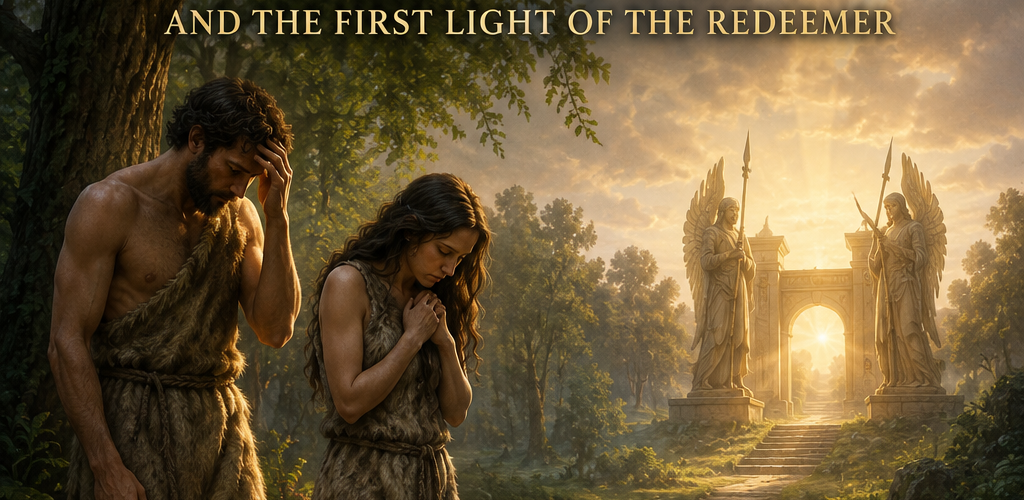
THE UNTOLD BIBLE TRUE STORY: THE FALL OF MAN AND THE FIRST PROMISE OF REDEMPTION


THE UNTOLD BIBLE TRUE STORY: THE FALL OF MAN AND THE FIRST PROMISE OF REDEMPTION
THE FIRST WOUND OF SIN, AND THE FIRST LIGHT OF THE REDEEMER
STORY OVERVIEW
Genesis 3 is often read as the story of humanity’s fall, but it is also the beginning of a promise. In the very moment when sin enters the human story, God speaks words that the Douay-Rheims itself identifies as “The promise of a Redeemer.” Scripture gives us no invented details about Adam and Eve’s emotions beyond what they say and do. Yet what it does reveal is profound: disobedience brings shame, fear, suffering, and death, but God’s judgment is accompanied by a mysterious promise concerning the woman, her seed, and the serpent.
SETUP
God had created man and placed him in paradise. He commanded him concerning the tree of knowledge: “Of every tree of paradise thou shalt eat: But of the tree of knowledge of good and evil, thou shalt not eat.” Genesis 2:16-17. The woman was created as man’s companion, and Scripture declares, “Therefore a man shall leave father and mother, and shall cleave to his wife: and they shall be two in one flesh.” Genesis 2:24.
CONFLICT
The serpent questioned God’s command. He contradicted the warning of death and promised that eating would open their eyes. The woman saw the tree as good, beautiful, and desirable; she ate and gave to her husband, who also ate. Genesis 3:1-6. Immediately, the consequences appeared. “The eyes of them both were opened,” and they recognized their nakedness. They hid from God. Genesis 3:7-8. (Douay-Rheims Bible)
TURNING POINT
Then came one of Scripture’s most searching questions: “Where art thou?” Genesis 3:9. Adam answered that he was afraid and had hidden himself. Genesis 3:10. God confronted the sin, and Adam and Eve each answered for what had happened. Scripture does not portray the excuses as healing the wound. Sin has entered creation, and judgment follows.
But judgment is not the final word.
God says to the serpent: “I will put enmities between thee and the woman, and thy seed and her seed: she shall crush thy head, and thou shalt lie in wait for her heel.” Genesis 3:15. (Douay-Rheims Bible) This verse is traditionally called the Protoevangelium, the “first Gospel,” because Catholic interpretation sees here the first biblical announcement of victory over the serpent through the promised Redeemer.
OUTCOME
The consequences are severe. The woman is told of sorrow and the pains of bringing forth children; Adam is told that the earth will bring forth thorns and that he will eat bread “in the sweat of thy face” until returning to the earth. Genesis 3:16-19. Yet even here Scripture records an act of divine care: “the Lord God made for Adam and his wife, garments of skins, and clothed them.” Genesis 3:21. They are sent from paradise, and cherubim guard the way to the tree of life. Genesis 3:22-24. (Douay-Rheims Bible)
The Bible does not tell us every detail of what Adam and Eve understood at that moment. It does tell us that humanity’s exile begins under the shadow of a promise.
DEEPER SPIRITUAL MEANING
The first temptation was not merely about fruit. Scripture presents a struggle over whether God’s word would be trusted. The serpent denied God’s warning; the human beings chose disobedience; then fear and hiding followed. Genesis 3:1-13. The pattern remains recognizable: temptation distorts God’s command, sin promises freedom, and sin instead produces bondage.
Yet God does not abandon His creatures. Catholic theology teaches that the fall wounded human nature and that original sin is transmitted to humanity, while baptism restores sanctifying grace through Christ. The full remedy is revealed progressively through Scripture and reaches its fulfillment in Jesus Christ.

CONNECTION TO JESUS CHRIST
Saint Paul explains the connection explicitly: “By one man sin entered into this world, and by sin death; and so death passed upon all men.” Romans 5:12. But he continues by contrasting Adam with Christ, declaring that grace and justification come through Jesus Christ. Romans 5:15-19. The first Adam’s disobedience points toward the obedience of Christ.
Thus Genesis 3 is not merely about how humanity fell. Read in the light of the whole Bible, it begins the long story of how God will restore what sin wounded.
CONNECTION TO MARY
Genesis 3:15 speaks of “the woman” and “her seed.” Catholic tradition reads this passage in connection with Christ and the Blessed Virgin Mary, especially in light of the Gospel’s presentation of Mary as the Mother of Jesus. The Genesis passage itself does not name Mary; therefore this Marian connection is Catholic theological interpretation, not a claim that Genesis explicitly identifies her by name. In Catholic tradition, Mary’s obedient “fiat” stands in profound contrast to the disobedience represented in Genesis 3, while Christ is the Redeemer who conquers sin.
RELEVANT SAINTLY WITNESS
Saint Paul is especially relevant because Scripture itself gives his inspired reflection on Adam and Christ. His teaching in Romans 5 prevents us from treating Genesis 3 as an isolated ancient tragedy. The Church reads the fall within the larger mystery of salvation accomplished by Christ.
THE HIDDEN CATHOLIC LESSON
One easily missed detail is that the first promise of redemption is spoken before humanity can repair anything. Adam and Eve have not earned restoration. They have sinned, hidden, and faced judgment. Yet God speaks of the serpent’s eventual defeat.
This teaches a crucial Catholic truth: God’s mercy does not mean pretending sin is harmless. God judges sin truthfully, yet His providence is already moving toward redemption. Repentance begins when we stop hiding and allow God to confront what is wounded within us.
WHAT THIS STORY REVEALS ABOUT GOD
God is holy because He does not simply overlook disobedience. He is just because consequences follow sin. He is patient because He calls the guilty person into the light: “Where art thou?” Genesis 3:9. He is provident because even within judgment He gives a promise and clothes the fallen. Genesis 3:15, 21. Scripture therefore reveals neither a cruel God nor a God indifferent to sin, but the Lord whose justice and mercy belong together.
A CATHOLIC REFLECTION FOR TODAY
Perhaps you recognize Adam’s hiding. Perhaps there is something in your life that you would rather conceal from God, from others, or even from yourself. Genesis reminds us that God already knows where we are. His question is an invitation to come into the light.
Do not confuse repentance with despair. The God who pronounced judgment also spoke the first promise of redemption. Bring your sin to Him honestly. Seek His mercy. Return to prayer. Receive the grace Christ gives through His Church. The road back to God begins not with pretending that we have never fallen, but with allowing the Lord to find us where we are.
REFLECTION QUESTIONS
Where am I hiding from God? Which temptation most easily makes me distrust His word? Do I excuse my sins instead of taking responsibility for them? Where do I need genuine repentance? Do I believe God’s mercy can reach me after failure? How can Christ’s obedience reshape my own obedience today? What does Genesis 3:15 awaken in me about God’s plan of salvation?
CONCLUDING PRAYER
O Almighty and merciful God, You saw humanity fall and did not abandon Your creatures. Give me grace to recognize sin, courage to repent, humility to obey Your word, and confidence in the redemption promised and fulfilled in Jesus Christ. Keep me from hiding when I have sinned. Lead me back into Your light, and teach me to trust Your mercy. Through Christ our Lord. Amen.

