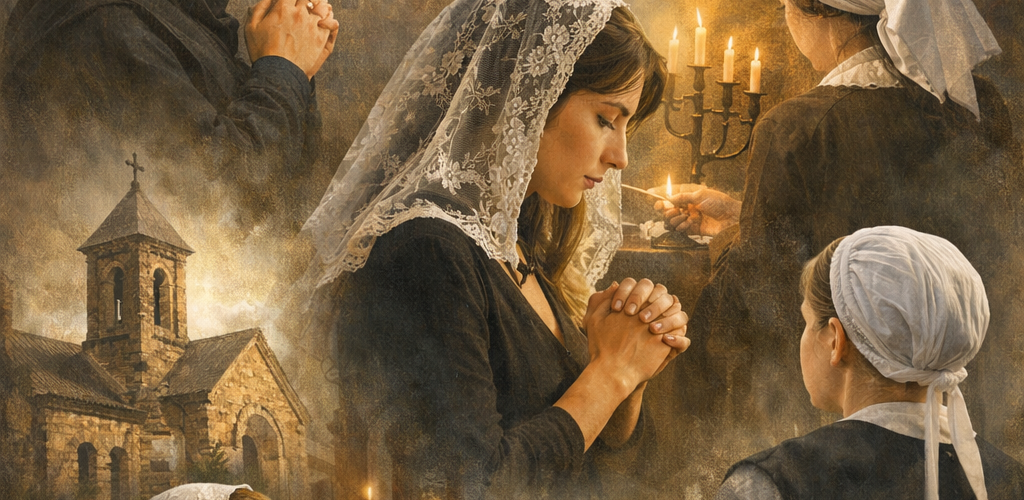
WHY WOMEN COVER THEIR HEADS IN CHURCH: TRADITION, SYMBOLISM, AND MODERN PERSPECTIVES


WHY WOMEN COVER THEIR HEADS IN CHURCH: TRADITION, SYMBOLISM, AND MODERN PERSPECTIVES
The practice of women covering their heads in church is one that has sparked curiosity, debate, and reflection across generations. While it is no longer universally observed, it remains deeply meaningful in certain Christian traditions. To understand this custom, we must explore its biblical roots, symbolic meaning, historical development, and how it is interpreted today.
Biblical Foundations
The primary basis for head covering comes from the New Testament, particularly a passage in 1 Corinthians 11:2–16. In this section, the Apostle Paul discusses appropriate conduct during worship, including the idea that women should cover their heads while praying or prophesying.
This instruction has often been understood as reflecting a spiritual principle tied to authority and order within worship. However, interpretations vary widely. Some see it as a timeless command, while others believe it was meant specifically for the cultural setting of the early church.
A Symbol of Modesty and Reverence
For many, the head covering represents more than a rule—it is a symbol. It expresses humility, reverence, and a posture of respect before God. Rather than drawing attention to oneself, it reflects a desire to focus on worship and spiritual devotion.
This idea of modesty is not unique to Christianity. Other religious traditions also incorporate head coverings as a sign of reverence and discipline, reinforcing the broader human impulse to honor the sacred through outward practices.
Representation of Spiritual Order
Another common interpretation connects head coverings to the concept of spiritual hierarchy described in the same biblical passage. The structure—God, Christ, man, and woman—is seen by some as a framework of order rather than inequality.
Within this view, the covering becomes a visible acknowledgment of that order. Still, this perspective is not universally accepted, and many modern readers question or reinterpret these ideas in light of contemporary values.

Historical Church Tradition
Historically, head covering was a normal part of life, not just in church but in public settings. Early Christian women commonly wore veils or coverings, and this continued for centuries.
In fact, in many churches, including Catholic and Orthodox traditions, women regularly covered their heads during worship until the mid-20th century. Even today, some groups—such as Mennonites and Amish communities—maintain the practice as an essential part of their faith expression.
Cultural and Social Context
Understanding the cultural background of the early church is essential. In ancient Mediterranean societies, a covered head was associated with honor, modesty, and respectability. An uncovered head, in contrast, could signal rebellion or impropriety.
Some scholars argue that Paul’s instructions were shaped by these cultural norms, aiming to preserve order and avoid misunderstandings within the community. If this is the case, the teaching may have been more situational than universal.
Modern Interpretations
Today, Christians approach this practice in different ways:
- Literal Interpretation: Some believe the instruction still applies today and continue the practice as an act of obedience.
- Cultural Interpretation: Others see it as specific to the first century and not binding in modern contexts.
- Personal Conviction: Many women choose whether or not to cover their heads based on personal faith, spiritual reflection, or tradition.
Conclusion
The question of why women cover their heads in church does not have a single answer. It sits at the intersection of scripture, tradition, culture, and personal belief. For some, it is a meaningful act of devotion. For others, it is a historical practice that no longer applies.
Ultimately, the practice highlights a broader theme within faith: how outward expressions relate to inward belief. Whether observed or not, its significance lies in the intention behind it—honoring God in a way that aligns with one’s understanding and conviction.
