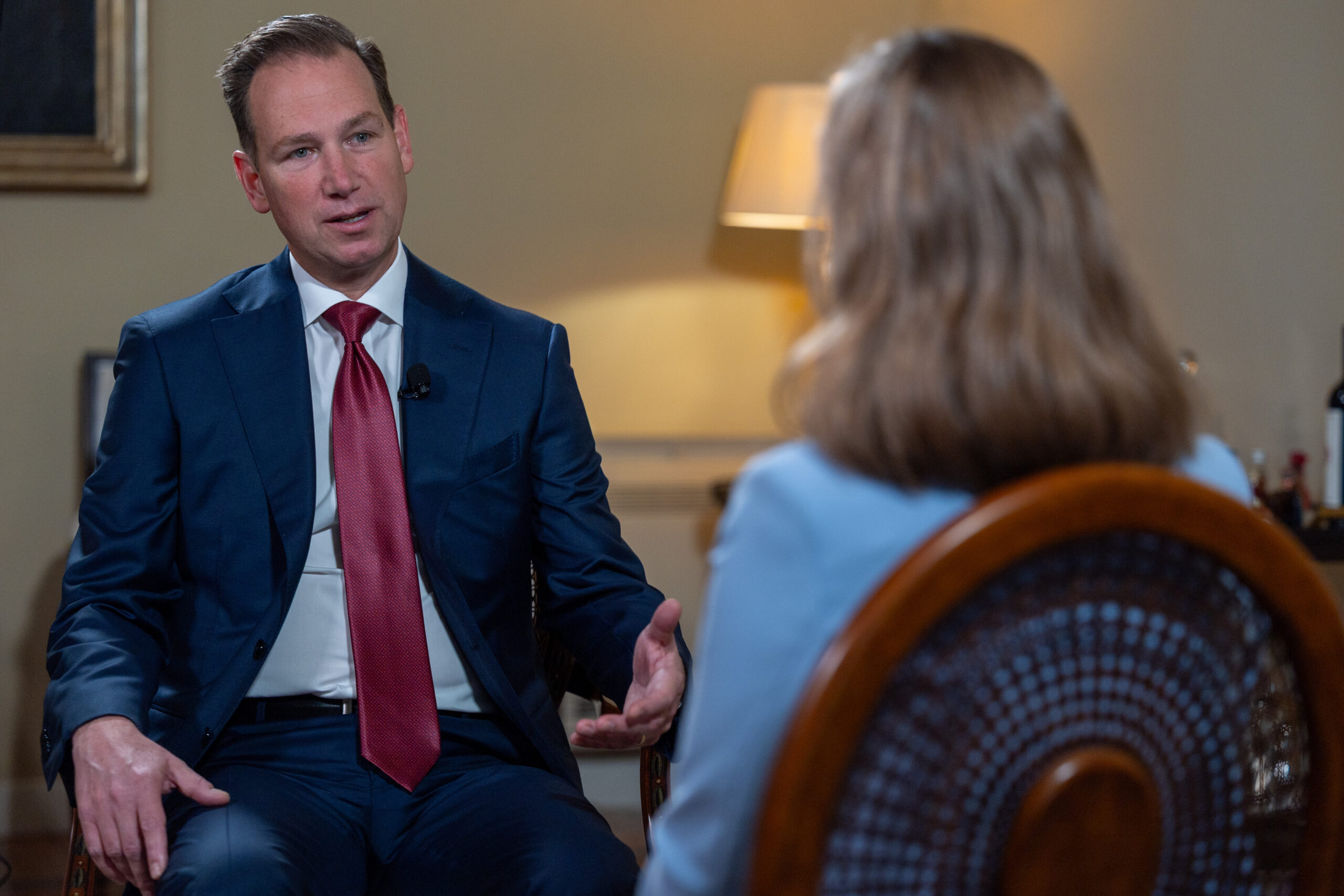
ROME — United States Ambassador to the Holy See Brian Burch has defended President Donald Trump’s deportation policies amid criticism from Pope Leo XIV and the U.S. bishops.
“The larger question of immigration is something that will constantly be a source of debate and conversation between the U.S. and the Holy See,” the ambassador acknowledged in an interview with EWTN News’ Colm Flynn and Hannah Brockhaus.
He added that Trump “had the courage to do something very difficult. I think people sometimes underestimate the difficulty of unwinding the chaos that had occurred” in the U.S. immigration system.
Leo has called for migrants to be treated with dignity, using the word “inhuman” to refer to the immigration crackdown in the U.S. He has also supported the U.S. Catholic bishops in their statements opposing the indiscriminate mass deportation of immigrants who lack legal status.
Burch pushed back on widespread criticism in the U.S. of immigration enforcement, especially following violence in Minneapolis, including the killings of two U.S. citizens.
“The thing that frustrated me is there was a lot of accusations that somehow this was borne out of some xenophobia or hate when I know this administration, this president, is deeply committed to protecting the safety and security of our country,” Burch said.
From advocacy to diplomacy
Burch, 50, presented his credentials to Pope Leo on Sept. 13, 2025, beginning his term as ambassador after he was nominated by Trump in December 2024.
From 2005 to early 2025, Burch was president of CatholicVote Civic Action and the CatholicVote Education Fund, organizations dedicated to promoting Catholic engagement in political life.
During his time with CatholicVote, he became a nationally recognized figure in Catholic political advocacy.
When asked about being a so-called MAGA Catholic, he said: “I’m proud of it.”
“I’m proud to have worked to elect this president. I’m proud to have represented [Trump during] what I think was a very important inflection point in our country,” Burch said.
Asked if it was difficult to transition from political advocacy to diplomacy, Burch said while being a diplomat does mean restraining his long-held love for debate, it “doesn’t mean you check your beliefs or your principles at the door.”
“I always liked political debates. I was probably more of a troublemaker sometimes, getting involved in debates and clubs at school … Now I’m a provocateur of a different sense, hopefully in a better way. But I always enjoy the public debate around politics and issues,” he said.
Noting that the Holy See and the U.S. have had full diplomatic relations since 1984, he added that he was stepping “into a position that was bigger than me.”
“Part of my job here is to build consensus, to help the Holy See to understand the policies and aims of the administration, and to build bridges between the two sovereign states,” he said.
He acknowledged the controversy surrounding some of Trump’s foreign policy efforts as well as his immigration policies. But he denied that his job as ambassador is “explaining Trump” to the Vatican.
“For me, it’s about a set of ideas. It’s about a set of priorities that this president is advancing,” he said.
“It’s explaining why what we’re doing is necessary, is right, is good for the United States, is good for the world. I don’t see a conflict there. I think people want to make it into a personality fight between the pope and the president. That’s not what it’s about,” Burch added.
The U.S. and the Catholic Church
Burch rejected the notion that the Vatican is anti-American. “The Holy See and United States share this common bond about truth and justice and human dignity and fundamental understanding of freedom. These are perennial things that transcend politics.”
On the other hand, the ambassador noted that there are “areas of prudential judgment where we may agree on the end but disagree on the means.”
“That’s the case in a lot of different political questions. But I think on the fundamental questions, certainly the protection of life, the importance of the family, the right of parents to direct the education of their children, the need to advance peace and justice around the world, there’s no disagreement between the Vatican and the United States,” he said.
Burch dismissed the suggestion that the pope’s decision not to visit the U.S. this year reflects any friction between the U.S. and the Vatican. The ambassador said he believes one factor was Leo’s desire to avoid the appearance of “attempting to influence the midterm elections.”
The ambassador said he thinks the pontiff will travel to his birth country the following year — “it will undoubtedly be one of the biggest trips he makes as the pope.”
He said it is not just the U.S. that wants to collaborate with the Holy See; the Vatican also seeks out information from the U.S.
“Depending on the conflict, often the United States is at the forefront of trying to drive towards a solution,” he said, explaining that when he meets with representatives of the Holy See, they want to know the latest news about negotiations and terms in countries like Venezuela, Cuba, Russia, and Ukraine.
According to Burch, the Holy See wants to know “how can we help, how can the Holy Father help, can he speak into this, or what role can the Church play in that local conflict?”
How the local Church can help in conflict zones or areas of persecution is “a frequent topic of conversation,” he added.
“Venezuela is 70% Catholic; the bishops in Cuba are one of the most important voices for the people there. Certainly, the Church in Europe [is important], the Church in the Holy Land sits right between two populations that have been in conflict for centuries,” he elaborated.
“The U.S. really does see the Church as this global actor that has such an important role to play and how we go about trying to solve some of the problems,” he said.
Defending a civilizational idea
According to the ambassador, the current U.S. administration’s project is about asking “What are we fighting for? What are we trying to defend?” as Secretary of State Marco Rubio outlined in his Feb. 14 speech at the Munich Security Conference.
“I think [Rubio] made very clear that we’re defending a heritage, a Western civilizational idea that has informed both the United States and Europe,” Burch said, adding that the Church has guided this idea through its intellectual tradition, history, and moral teaching.
“We are defending a way of life, a way of life informed by faith and formed by deep principles of human dignity and freedom, without which the world would be chaos,” he opined.
“The Holy See and the U.S. are both aligned — in a larger historical sense — to both defend and recover this heritage that I think has made the world what it is today.”
