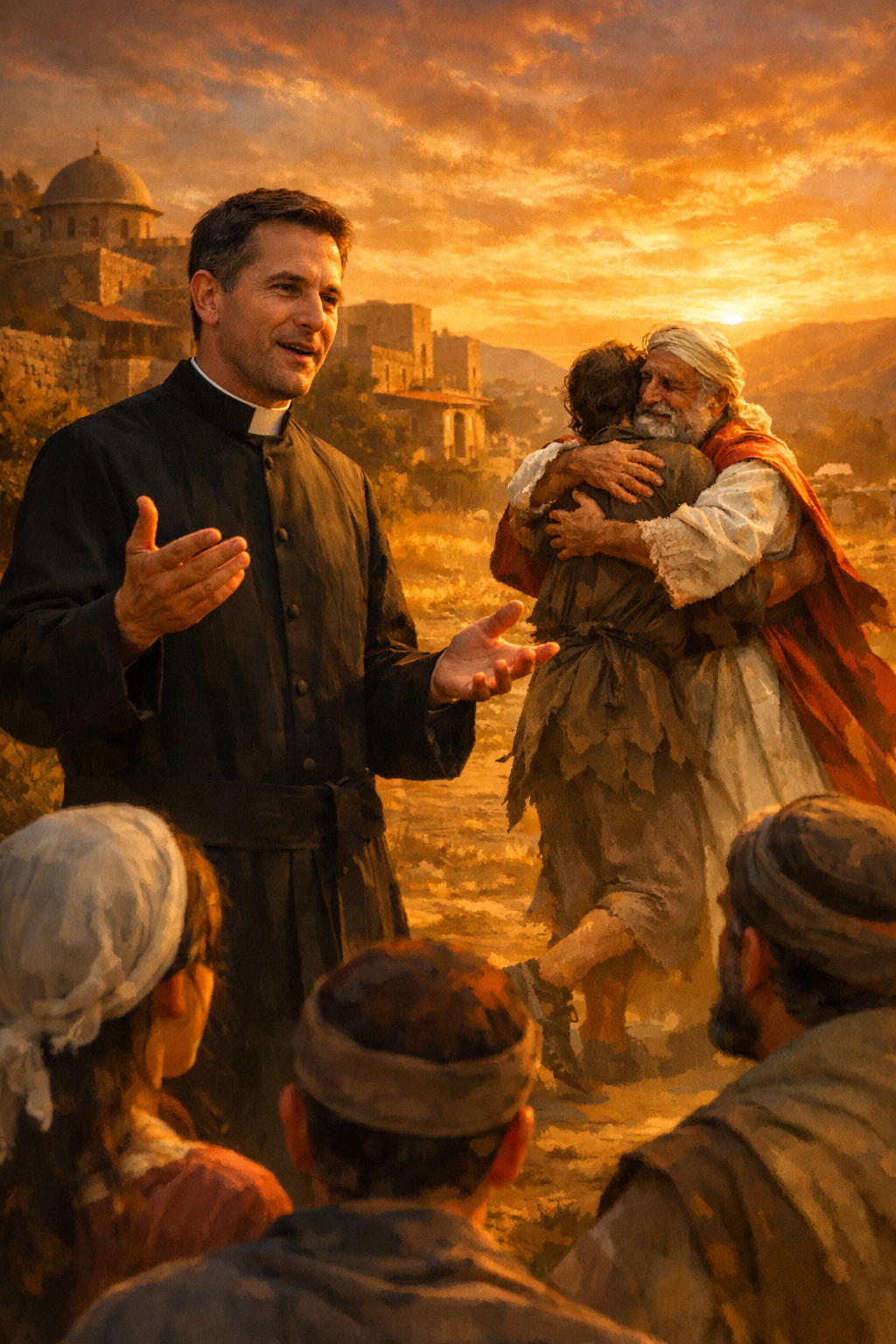
CATHOLIC DAILY GOSPEL REFLECTION FOR TODAY, MARCH 7, 2026
THE FATHER WHO RUNS: A STORY OF MERCY THAT NEVER GIVES UP
FEATURED GOSPEL (DOUAY-RHEIMS)
Luke 15:20–24
“And rising up he came to his father. And when he was yet a great way off, his father saw him, and was moved with compassion, and running to him fell upon his neck, and kissed him.
And the son said to him: Father, I have sinned against heaven and before thee: I am not now worthy to be called thy son.
But the father said to his servants: Bring forth quickly the first robe, and put it on him, and put a ring on his hand, and shoes on his feet:
And bring hither the fatted calf, and kill it, and let us eat and make merry:
Because this my son was dead, and is come to life again: was lost, and is found. And they began to be merry.”
LITURGICAL DAY
SATURDAY OF THE SECOND WEEK OF LENT
OPENING REFLECTION
Few stories in the Gospel touch the human heart as deeply as the parable of the prodigal son. We recognize ourselves in this story: moments when we wander far from God, when pride leads us away, and when we finally realize how much we need mercy.
Yet the true center of this story is not the lost son—it is the loving Father. Jesus reveals a God who does not wait coldly for us to return but who runs toward us with compassion.
UNDERSTANDING THE GOSPEL
Jesus tells this parable in response to criticism from the Pharisees. They complain that He welcomes sinners and eats with them (Luke 15:2). In response, Jesus tells three stories about what is lost and found: the lost sheep, the lost coin, and finally the lost son.
Historical and Biblical Context
In Jewish culture, the younger son’s request for his inheritance while his father was still alive was deeply insulting. It was almost like saying, “I wish you were dead.” By taking the inheritance and leaving, he breaks family and cultural bonds.
His descent into poverty—feeding swine—was especially humiliating for a Jew, since pigs were considered unclean animals.
The Message Jesus Communicates
The turning point of the story is when the son “came to himself.” Realizing his misery, he decides to return—not expecting full restoration but hoping only to be treated as a servant.
But the father does something shocking. He runs to his son. In ancient culture, dignified patriarchs did not run. Yet this father throws aside dignity out of love.
The robe, ring, and sandals symbolize restoration:
-
Robe – honor restored
-
Ring – authority and belonging
-
Sandals – freedom as a son, not a slave
The feast celebrates the miracle of reconciliation.
ORIGINAL LANGUAGE INSIGHT
The Gospel says the father was “moved with compassion.”
The Greek word used is “splagchnizomai.”
This word literally refers to a deep, gut-level compassion—an overwhelming emotional mercy that moves someone to action. It is the same word often used to describe Jesus’ own compassion.
This means the father’s mercy is not reluctant or distant. It is powerful, heartfelt, and immediate.
God’s mercy comes from the deepest love.
INSIGHT FROM THE CHURCH
St. Augustine of Hippo reflected on this parable by saying that the younger son represents every sinner who wanders from God, while the Father represents the boundless mercy of God.
The saint wrote that when the son returned, the Father did not question him but embraced him, showing that God rejoices more in repentance than in condemnation.
The Church has always seen this parable as a powerful image of the Sacrament of Reconciliation, where the sinner returns and the Father restores dignity and grace.
WHAT THIS GOSPEL MEANS FOR US TODAY
Many people today carry guilt, regret, or a sense of spiritual distance from God. Some feel they have gone too far or failed too many times.
But this Gospel reveals a truth that changes everything:
God never stops waiting for us.
He watches the road for our return.
Like the prodigal son, we sometimes chase things that promise happiness but leave us empty—success, pleasure, pride, or independence from God.
Yet when we turn back—even with trembling steps—God does not shame us.
He welcomes us.
This story also challenges those who resemble the elder brother, who resents mercy given to others. Sometimes we struggle to accept that God loves sinners just as passionately as He loves the faithful.
The Father reminds us: mercy is not earned—it is given.
LIVING THE GOSPEL TODAY
Here are three simple ways to live this Gospel today:
1. RETURN TO GOD IN PRAYER
Even if you feel spiritually distant, take a few minutes today to speak honestly with God.
2. GO TO CONFESSION
The Sacrament of Reconciliation is the modern experience of the Father’s embrace.
3. SHOW MERCY TO SOMEONE
Forgive someone, reach out to a struggling friend, or give compassion instead of judgment.
SHAREABLE FAITH QUOTE
“No matter how far we wander, the Father’s mercy is already running toward us.”
CONCLUDING THOUGHT
The prodigal son’s story reminds us that our failures are never the end of the story. God’s mercy is always greater than our sin. When we take even one step back toward Him, He comes running with compassion.
In this Lenten season, we are invited to return home—to the Father who never stops loving us.
CLOSING PRAYER
Heavenly Father,
You are rich in mercy and full of compassion.
When we wander from Your ways, call us back to Your love.
Give us the humility to return to You and the courage to trust in Your forgiveness.
Help us to show the same mercy to others that You show to us.
May we always find our home in Your heart.
Amen.
SEO-FRIENDLY KEYWORDS
-
Catholic Gospel Reflection March 7 2026
-
Prodigal Son Reflection
-
Luke 15 Catholic Reflection
-
Lenten Gospel Reflection
-
Catholic Daily Devotional
